


Personal WhatsApp vs Official WhatsApp Business API for Indian Businesses (2026 Guide)
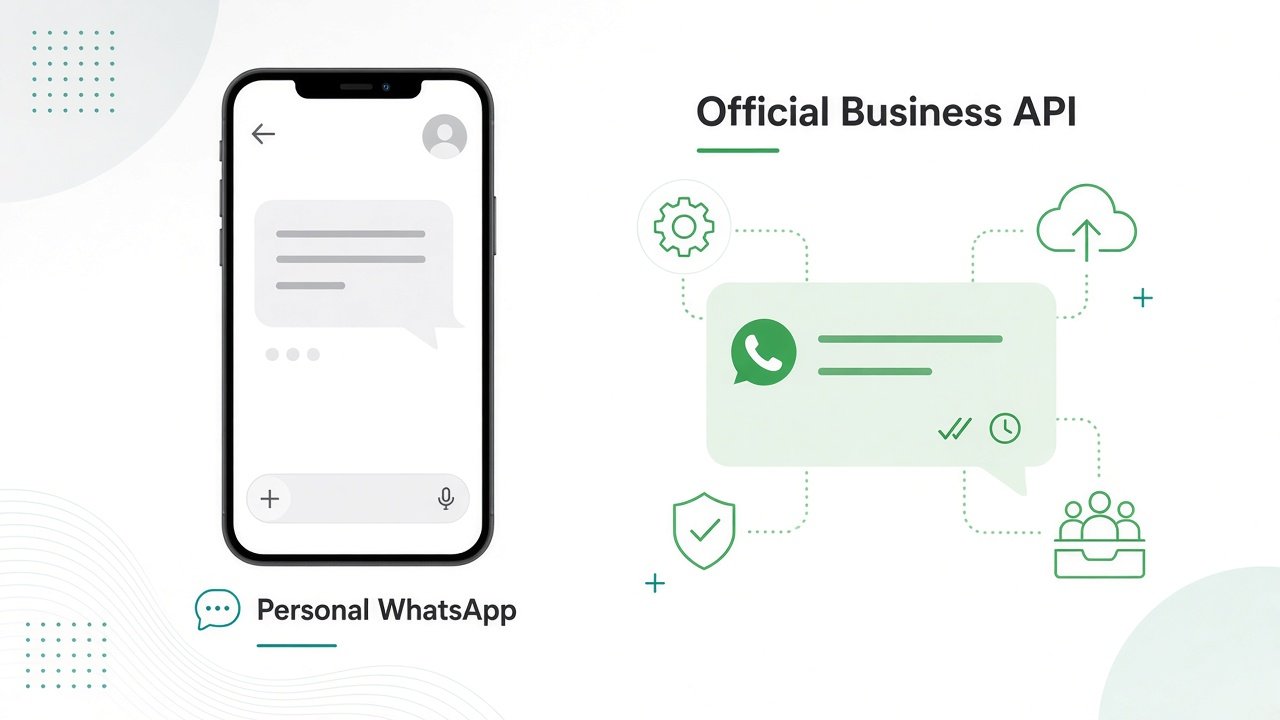
Personal WhatsApp vs Official WhatsApp Business API for Indian Businesses
If you run a clinic in Chennai, a coaching centre in Coimbatore, or an ecommerce brand shipping pan-India, WhatsApp is probably already your default customer channel. The confusion starts when growth hits a wall: one phone, one person typing, and a growing fear of account bans after “bulk” experiments.
Three tools get mixed up constantly:
1. Personal WhatsApp (the consumer app)
2. WhatsApp Business App (free app for small businesses)
3. Official WhatsApp Business API (Cloud API via Meta’s platform — often through a partner)
This guide separates them clearly so you can choose the right path—without fake promises or grey-area workarounds.
Why this distinction matters in India
Indian customers expect replies on WhatsApp. But Meta’s rules, spam filters, and quality ratings treat unofficial automation and mass messaging from personal numbers harshly. Many businesses only learn this after a number gets restricted.
A simple rule of thumb:
• Conversation quality and trust → start with the Business App if you are still small.
• Scale, templates, teams, and CRM → plan for the Official WhatsApp Business API.
Digi Soft Marketing Solutions (2Desh) focuses on Official API clients in Tamil Nadu and worldwide—facts first, soft sell.
Personal WhatsApp: what it is (and isn’t)
Personal WhatsApp is built for people, not operations.
Good for
• Founders talking to a handful of clients
• One-to-one follow-ups
• Informal updates when volume is low
Limits
• One device / one primary user experience
• No official business profile tools like the Business App
• No approved message templates for notifying customers at scale
• High risk if you connect unofficial “bulk sender” tools or scrapers
If someone sells you “unlimited WhatsApp blasting from your personal number,” treat that as a red flag. It is not the Official API, and it often violates WhatsApp’s terms.
WhatsApp Business App: the right starter for many SMBs
The WhatsApp Business App is free and designed for small teams that still work largely from one phone (or a few labeled devices under Business App features).
Useful features
• Business profile (address, hours, catalog links)
• Quick replies and away messages
• Labels for simple organisation
• Catalog for product browsing (where available)
Still not ideal when you need
• Multiple agents in a shared inbox with proper roles
• Automated order/appointment/payment templates that customers can receive outside a 24-hour window (subject to Meta rules)
• Deep CRM integration and workflow automation
• Reliable high-volume transactional messaging
Many Tamil Nadu clinics, salons, and local retailers can run happily on the Business App for months. The upgrade moment is usually when the owner becomes the bottleneck.
Official WhatsApp Business API: what “official” actually means
The Official WhatsApp Business API (WhatsApp Business Platform / Cloud API) is Meta’s enterprise messaging channel. Businesses typically access it through:
• Meta’s own developer / Embedded Signup flows, or
• A Meta-authorised Business Solution Provider (BSP) / tech partner that hosts the connection, templates, and tooling
What you generally get
• A dedicated business number registered on the Cloud API (not your day-to-day personal chat app)
• Template messages for approved use cases (order updates, reminders, utility notifications—subject to Meta policy and approval)
• Team inbox / multi-agent handling (via your platform)
• Webhooks and CRM / ecommerce integrations
• Quality rating and messaging limits that scale with good behaviour
What it is not
• A licence to spam strangers
• A guarantee of “open rates” or sales
• The same thing as the free WhatsApp Business App
• The same thing as unofficial personal-number bulk tools
Confusing “API” marketing with grey tools damages trust and puts numbers at risk.
Side-by-side comparison
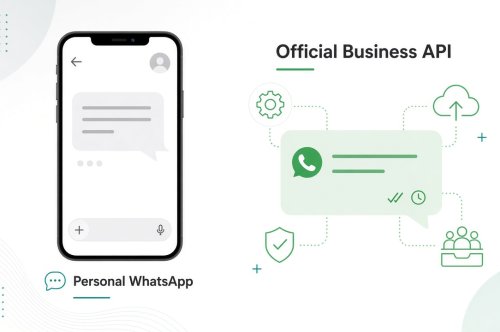
Need — Personal WhatsApp — Business App — Official Business API
One-to-one chats — Yes — Yes — Yes (via platform)
Business profile basics — Limited — Strong — Strong (via Meta + partner)
Shared team inbox — No — Limited — Yes
Approved templates / many notifications — No — Limited — Yes (with approval)
CRM / website / payment workflows — Manual — Manual / light — Built for integration
High-volume compliant ops — No — Rarely — Designed for this
Ban risk from unofficial bulk tools — High if abused — High if abused — Lower when used per policy
When Indian businesses should move to the Official API
Consider the Official API when two or more of these are true:
• You send recurring appointment, order, delivery, or payment updates
• More than one person needs to reply without sharing one phone
• You want chatbot flows for FAQs, lead capture, or catalog browsing
• You need messages to land in a CRM (clinics, colleges, ecommerce, agencies)
• Your customer base is growing across Tamil Nadu / India / export markets and phone-based WhatsApp no longer scales
You may not need the API yet if you have under a few dozen conversations a day and one person can handle them well on the Business App.
Realistic setup checklist (India)
Exact document lists and timelines change with Meta’s processes, so treat this as a practical outline—not a guarantee:
1. Registered business entity and matching paperwork (often GST / incorporation / other accepted government docs)
2. Meta Business Manager account and Business Verification (name/address/docs must align)
3. A phone number that can be registered for Cloud API use (commonly one not already active on WhatsApp in a conflicting way—your partner will guide migration)
4. A clear display name that matches how customers know you
5. A live website and privacy/policy basics (helps trust and verification)
6. First message templates written for real use cases (not spammy promo blasts)
7. Onboarding via Embedded Signup or a partner platform such as 2Desh (https://2desh.com / https://app.2desh.com)
Timelines vary. Verification delays are common when legal names and documents do not match. Plan for iteration, not overnight miracles.
Soft sell: how Digi Soft / 2Desh fits
DIGI SOFT MARKETING SOLUTIONS helps businesses choose the honest path:
• Official WhatsApp Business API platform: 2desh.com / app.2desh.com — team inbox, automation, templates, multi-channel workflows
• Also: SMS / RCS / voice, CRM, custom websites — plus guides on digisoftwar.com
We prioritise WhatsApp API clients in Tamil Nadu and worldwide. No guaranteed approval times, delivery rates, or “unlimited blasting.” If the Business App is enough, we will say so.
Next step: Visit 2desh.com or contact Digi Soft via the site. Bring your use case (clinic reminders, admissions updates, order alerts, support inbox)—we will map whether Official API fits.
Key takeaways
• Personal WhatsApp ≠ Business App ≠ Official Business API.
• Unofficial bulk tools on personal numbers are a common source of bans and broken trust.
• Start simple; upgrade when teams, templates, and CRM matter.
• Official API success depends on verification hygiene, template quality, and respectful messaging—not hype.
Also explore on digisoftwar.com: WhatsApp Business AI India Setup Playbook, WhatsApp Business API India Implementation Kit, and related SMB kits.
Digi Soft / 2Desh — Chennai · 2desh.com · app.2desh.com · digisoftwar.com · +91 95665 27786 · [email protected]